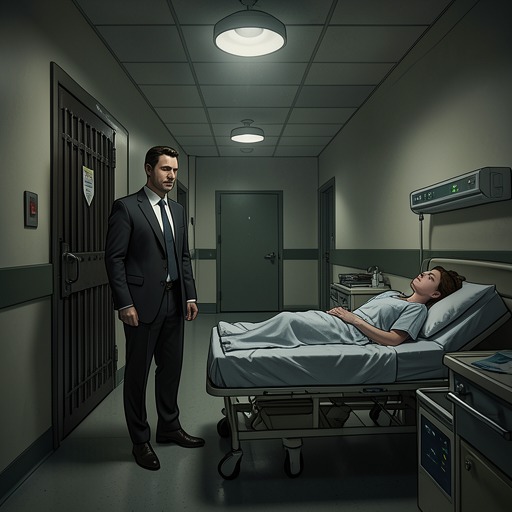
Gloria's Confession and Reconciliation with Jensen
I'm Still Here- What didn't kill me made me stronger and sharperGloria's Confession and Reconciliation with Jensen is the confrontation in which Gloria Simpson Picou finally explains why she abandoned Jensen Brick McCall and acknowledges the choices that shaped his life. The exchange does not erase the attempted abortion or the years of separation. Instead, it makes reconciliation possible by putting the truth, including Gloria’s responsibility and Jensen’s anger, into words. Its movement is deliberately cautious: Jensen asks for remorse and knowledge, and offers a future relationship only one day at a time.
Causes and Background
Jensen’s origin gives the conversation its moral weight. On December 4, twelve late-term abortions were performed at the clinic where Grace McCall worked. A baby born to Gloria survived for eight hours on the table, despite the clinic’s expectation that the infants would die. After Jensen’s birth, Grace called Gloria to say he was alive; Gloria told the staff to let him die. Grace instead saved him. She later told him that his survival was a miracle and that he had a purpose, but that religious framing could not answer the central human question of why his own mother had rejected him.
The wound had already shaped Jensen’s understanding of himself before Gloria offered an explanation. He described her as his murderer because she had tried to end his life and then refused to take him home. He connected that beginning to a life of merely existing, rather than feeling that he had lived. The phrase was not a literal account of a later attack: it named the emotional and bodily force of discovering that the person who gave birth to him had once chosen his death.
The book also places the confession against a longer path toward contact. Gloria’s estrangement from Jensen had already been exposed during an earlier meeting with Ginger Pearl, when Jensen disclosed the circumstances of his birth and Ginger Pearl recognized him as her grandson. In a separate embrace with Gloria, Jensen could acknowledge that love was present while still unsure whether this would be their only meeting. That moment gave him an explanation and an opportunity, but did not settle the questions he still needed to ask. The later conversation therefore moves beyond recognition toward explicit accountability.
The Confrontation and Confession
The scene is framed as a conversation between a mother and son who share DNA but have no settled bond. Jensen sees Gloria in his space and measures the distance between biological connection and emotional history: he believes he should have been protecting her and helping her through dialysis, yet cannot make that duty feel natural after her attempted rejection of him. When she asks what he wants, he answers that he wants remorse and the chance to know who she is. He also refuses to accept a sentimental performance of unconditional love from someone he believes has not shown it.
Gloria initially explains her silence as a failure to face the truth, admit wrongdoing, or discover how to make amends. Jensen does not let that explanation stand as a substitute for the facts. He tells her that her lack of care for him while he was alive belongs to her and his father, not to him, and insists that the conversation cannot be treated like a television story that can be switched off and forgotten. Gloria says she wants to get past the past and know her son. Her desire to begin again is thus tested against the history she had avoided.
Her most specific explanation links that avoidance to illness and shame. When she first went into renal failure, she interpreted it as punishment for the abortion and for not taking Jensen home. She says she welcomed her suffering because she believed she had damaged his life. Looking at him meant reliving the decision, and she could not face him because doing so would mean confronting the possibility that he would never forgive her. Jensen identifies this plainly as denial driven by guilt, and Gloria confirms that he is right. Her admission clarifies her behavior without making the harm disappear.
The confession also reaches the decision itself. Jensen asks whether Gloria would have told the clinic to let him die if he had been light-skinned. She first says she was not ready to be a mother, but he presses her not to use that answer to avoid his question. Gloria answers yes. The admission makes the exchange more than a general apology for absence: she acknowledges the racial dimension Jensen has asked her to face, as well as her stated unreadiness for motherhood. The truth hurts him, but it is no longer hidden behind silence.
Accountability, Family History, and Limits
Gloria apologizes for not coming to get Jensen, explaining that she was afraid of the trouble she might face and that her fear was foolish. When he asks who his father is, she identifies Tyrell Whidbee, a former drug dealer who became an activist and runs a community center in Watts. She says he inherited his father’s smile and height, and that she recently called him to tell him about Jensen. This disclosure expands the conversation from Gloria’s abandonment to a wider family history that Jensen had not been given.
Gloria also states directly that she wants Jensen in her life and wants the world to know he is her son. She apologizes for denying him and regrets not being present. Her request is not that he instantly resume the role of a son, but that he consider allowing her to be his mother rather than only the person he calls his murderer. Jensen does not grant a complete restoration of trust. He says he can imagine that possibility in the near future, but sets the pace at one day at a time and adds that good barbecue might help. The modest humor leaves room for contact without pretending the past has been repaired by a single conversation.
Reconciliation and Aftermath
The reconciliation is made visible through physical gestures as well as admissions. Gloria wraps her arms around Jensen’s waist; he remains nervous and uncertain about what to feel, but does not simply reject her. Earlier, he had held her and then let her go, describing the embrace as a moment in which love was winning and he could understand why she had left, even while unsure whether she would erase him or embrace him again. In the later conversation, that fragile opening becomes a more explicit negotiation: Gloria asks to know him, and Jensen permits a possible future while retaining the right to proceed slowly.
A later family crisis confirms the distinction between forgiveness and forgetting. When Gloria needs Jensen, Ginger Pearl urges him to forgive and love her as family. Jensen answers that he has forgiven Gloria and that they are together as a family, asking only that she get better. The statement marks a consequential change from his earlier insistence that Gloria was his murderer, but it does not retroactively make the abandonment harmless. Rather, the confession gives him the truth he demanded, and his later response shows him choosing connection without denying what happened.
Narrative Significance
The event reverses the direction of the original abandonment. At Jensen’s birth, Gloria’s decision was communicated through an instruction that he be left to die; in the confrontation, she must speak directly to the child who survived and accept his questions. Grace McCall’s act of saving him and her repeated belief in his purpose had kept his life story from ending at the clinic, but the reunion tests whether that life can include an honest account of his mother as both the person who rejected him and the person seeking a relationship now.
The scene treats reconciliation as a process rather than a pardon secured by one apology. Gloria’s suffering from renal failure helps explain the guilt she carried, but Jensen makes clear that her guilt cannot replace his experience or absolve her without his consent. He asks for remorse, insists on the missing facts, and sets a measured condition for moving forward. His eventual forgiveness is therefore an act of choice, not proof that the past has vanished. The family can gather around Gloria in illness because the truth has been spoken and Jensen has decided, cautiously, to remain connected.